
 Best Seller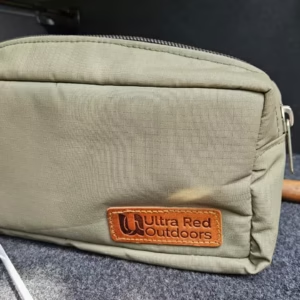
Soft Storage vs Hard Drawers: Which Suits Your Overlanding Rig
If you’re kitting out a 4×4 for serious overlanding, the storage debate eventually narrows to one question: soft storage vs drawers overlanding setups. Both work. Neither is universally “better.” The right answer depends on how often you go out, what you carry, and whether you value security and access over weight and flexibility.
We build vehicle-specific storage for overland rigs across Kenya and East Africa, and we see both ends of the spectrum every week: the tradesman with a single soft duffel in a Hilux, and the safari operator running partitioned drawer systems in a Land Cruiser fleet. Here’s how to think about which approach fits your build.
The decision: soft storage strengths vs hard drawer strengths
A practical way to frame it: soft storage is about flexibility, hard drawers are about discipline. Soft bags adapt to whatever you stuff in them and can move between vehicles, the house, the campsite, or the boot of a sedan. Drawers force structure on your kit. They lock in a layout, take up dedicated space, and reward you with predictable access on every trip.
If you head out twice a year for a weekend, the case for a full drawer system is weaker. If you live out of your vehicle for weeks at a time, or you run a safari fleet where guides need to find a spanner at 3am without unpacking the rig, drawers earn their keep quickly.
Where vehicle soft storage wins
- Weight savings. A roof bag, a safari pouch, and a couple of duffels weigh a fraction of a built drawer system. Lower payload means better fuel economy on long-haul corrugated roads and less strain on suspension.
- Flexibility. Soft bags reshape around their contents. Pack three days of food in one bag for a weekend, swap it for a tent and bedding bag for the next trip.
- Lower upfront cost. A soft kit is a fraction of the investment of a full custom drawer system — a practical entry point for someone testing the waters of overlanding.
- Reconfigurable. Add a third bag for a longer trip, leave one at home for a shorter one. Pull the lot out for a school run on Monday and the boot is empty.
- Cross-vehicle compatibility. A roof bag fits whatever rig you put under it. Drawers don’t.
Where overlanding drawers win
- Security. Lockable drawers keep tools, recovery gear, and valuables out of sight when you stop for fuel or food. A soft bag in plain view is an invitation.
- Organisation. Drawers turn your boot into a kitchen, a workshop, or a pantry. Cutlery has a slot. Spare fuses have a drawer. Nothing gets buried under everything else.
- Dust seal. Kenyan dirt roads put dust through everything. Properly fitted drawers with sealed lids protect contents far better than a zipped bag, especially over weeks on murram and corrugated tracks.
- Longevity. A heavy-duty drawer system built from high-quality materials, with ball-bearing slides rated for hard use, can outlast the vehicle.
- Daily-driver discipline. Because drawers stay fitted, your kit is always packed and ready. No scramble before a Friday afternoon departure.
Hard drawers vs soft bags: matching to use case
The clearest way to decide is to match the storage to the trips you actually do, not the trips you imagine doing.
Weekend trip, two or three times a year
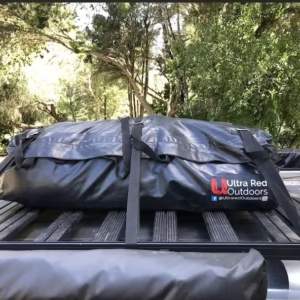
If your pattern is occasional weekend escapes — Naivasha, Magadi, the odd safari week — a well-chosen soft storage kit covers most needs. A roof bag for bulky low-density items like sleeping bags and tents, a safari pouch for small kit, and a couple of duffels in the boot will get you most of the way there.
Regular trips, multi-night, varied terrain
For anyone heading out monthly, especially for trips longer than two nights, the calculation flips. Setup time before each trip becomes the friction. Drawers eliminate that friction. A twin drawer system in a Hilux double cab or a Land Cruiser becomes the platform you build everything else around.
Full overland expedition or safari fleet
For weeks-long expeditions, or tour operators running fleets, drawers aren’t optional. Guides need to find gear in the dark without unpacking the rig. Recovery gear has to be accessible without lifting heavy bags. Food storage has to be dust-sealed. This is where vehicle-specific drawer systems with high-quality materials and ball-bearing slides justify the spend many times over.
Combining both: drawers as the base, soft bags as overflow
The dirty secret of experienced overlanders is that this isn’t really either-or. The mature setup uses both. Drawers form the structured base layer: kitchen kit, recovery gear, tools, fridge slide. Soft bags handle the rest — clothing, sleeping bags, tents, food that changes between trips. A roof bag carries bulky low-density items that would waste boot space. A safari pouch keeps small daily-use items in reach inside the cabin. You get the discipline of drawers for the kit that lives in the rig permanently, plus the flexibility of soft storage for trip-specific overflow.
Vehicle-specific considerations
The same storage logic doesn’t translate identically across vehicles.
- Land Cruiser 100, 200, 80, 76 series. Boot space and payload support full twin drawer systems comfortably. Vehicle-specific drawers for the Land Cruiser 100 Series use the boot floor and wheel arch geometry properly, so you don’t lose corner space the way a universal-fit unit would.
- Hilux double cab. Tray-style drawer fits work well, with the ute bed offering different geometry than an SUV boot. Soft bags supplement neatly on the back seat or roof bag.
- Prado, Pajero, Patrol. Vehicle-specific fits matter — the floor isn’t flat and a universal box wastes space.
- Smaller rigs (Jimny, smaller SUVs). Soft storage often wins by default because the boot is too compact to give up volume to a drawer chassis.
Build quality matters either way
Whichever route you go, materials decide longevity. On the soft-storage side, look for YKK zippers, heavy-duty fabric weave, reinforced stitching at stress points, and seams that handle the load you’ll actually put on them. On the drawer side, slides are the part that fails first on poorly built systems — ball-bearing slides rated for the loaded weight, fitted in heavy-duty construction, are non-negotiable for any drawer that will see real overland use.
The Kenya context is harsh: coastal humidity, inland dust, corrugations on unsealed roads, and big temperature swings between dawn and afternoon all stress storage gear. Cutting corners on materials shows up after the second or third long trip. The long-form overland gear coverage at Outside Online consistently makes the same point: durability over a decade, not the flashiest features at year one, separates serious kit from disposable. For drivers heading regularly into rougher routes, the guidance from AA Kenya on vehicle preparation and load management is worth a read before you finalise the plan.
How to think about the spend
Soft storage and drawers sit at very different points on the cost curve, but the more useful frame is cost-per-trip over the life of the build. A soft bag kit serves a casual user well for years at low cost-per-trip. A drawer system spread across 100+ trips and 10+ years works out to a small number per outing, especially when you factor in time saved on every load-out. For tour operators, the lifetime maths is even clearer: downtime and lost gear cost more than the build itself.
Spec your storage with Ultra Red Outdoors
If your trips are short and infrequent, begin with quality soft storage and a roof bag. If you’re heading out monthly, or you’re running a safari operation, the drawer investment pays back faster than most owners expect. Browse the drawers and slides range for vehicle-specific drawer systems built in Kenya, including regular twin drawers for common 4×4 platforms. For soft kit, the soft storage range includes the safari pouch for in-cabin organisation and roof bags for bulky low-density gear. Or browse the full Ultra Red Outdoors shop for live pricing and the vehicle-specific catalogue.
Built and fitted in Nairobi by Ultrared Outdoors
Every product mentioned on this page is designed, fabricated and professionally installed by our team in the Ultrared Outdoors workshop on Old Mombasa Road, Nairobi. We custom-fit each kit to your specific vehicle on the bench, then install it in-house. We do not ship flat-packed parts and walk away, and we do not work from templates that “almost fit”. Every aluminium roof rack, drawer system and 270-degree canopy awning we make is tested in real Kenyan conditions before it leaves the workshop floor.
We have built rigs for safari operators heading into the Mara, expedition teams crossing the Chalbi, and weekend overlanders who just want to camp comfortably in Naivasha or on Mount Kenya tracks. Whatever the use case, the build is custom to the vehicle and the way the vehicle is actually used. Request a quote with your vehicle make, generation and intended use, and our team will scope a build for you.