
 Best Seller
Best Recovery Boards for Sand and Mud Driving in Kenya
If you have watched three wheels of a Land Cruiser spin in soft Magadi sand or post-rain Tsavo black-cotton, you already know why recovery boards Kenya overlanders trust earn a permanent spot on a serious 4×4 rig. They are the fastest, lowest-risk way to self-recover when traction disappears, with no need for a second vehicle, a winch anchor or a long session with a shovel.
This guide covers when boards beat a winch or shovel, how sand and mud need different driving inputs, the stacking and bridging techniques that get you out faster, the build-quality criteria that matter, and the mounting options that keep boards reachable on real Kenyan terrain.
When Recovery Boards Beat a Winch or Shovel
A winch needs an anchor point. On an open Magadi pan or a Diani beach there is nothing within 30 metres to hook to, so the winch becomes dead weight on the bumper. A shovel works for short bog-downs but turns a 10-minute job into a one-hour sweat session in 35 degree coastal heat.
Boards win in the most common Kenyan stuck scenarios: soft sand on Magadi shoreline and the Loiyangalani approach, beach access tracks at Watamu and Diani, post-rain murram on rural C-class roads, wet clay on Aberdares forest tracks, and black-cotton soup in Tsavo and the western Mara conservancies. The recovery is solo, fast and repeatable: a board under each driving wheel, drive out, retrieve, stack on the rack. Under five minutes once you have done it twice.
They are not magic. They will not save a vehicle that has high-centred on a rock spine, drowned an air intake or stuck the chassis on a termite mound. For those, you still want a jack or a winch.
Sand vs Mud: Two Different Traction Problems
Sand and mud share the same boards but need opposite driving inputs.
Sand: Float, Don’t Dig
In dry sand the wheel is digging itself a hole. The board gives the tyre a long flat surface to climb. Lower tyre pressures first, typically 1.0 to 1.4 bar for soft sand depending on tyre profile and load. Clear sand from ahead of each driving wheel two tyre lengths forward. Wedge the lugs firmly under the tyre, angled slightly downward toward the direction of travel. Drive off in second-gear low range with smooth steady throttle: no spin, no aggressive bite. Once moving, do not stop until you are on firm ground.
Mud: Bite, Then Climb
In wet mud the wheel is spinning on a slick film. The lugs need to dig in and grip, not float. Keep tyre pressures closer to road pressure, only slightly reduced. Clear mud from ahead of the tyre so the board sits flush against the tread, press it firmly down so the lugs make contact, and drive off in low range with measured throttle. Mud needs torque, not wheel speed.
Black-cotton soil in Tsavo and the southern Mara is the toughest case in Kenya. Wet black-cotton is so sticky it can pull the lugs out of cheap boards on a first recovery. Scrape the board clean once the soil dries.
Stacking and Bridging: Two Techniques Worth Practising
A pair of boards is the working minimum. A four-board set unlocks two techniques that solve harder recoveries.
Stacking. For deep bog-downs, two boards stacked under each wheel raise the tyre out of the hole before forward motion begins. This works only with boards designed to nest, which most quality recovery boards are.
Bridging. For ruts, washouts and shallow ditches, boards span the gap and let the tyre roll over open ground that would otherwise drop the chassis. This is common on rural Kenyan tracks where heavy lorries have cut wheel-width grooves into the murram. A bridged board lets a Land Cruiser, Hilux or Defender clear the rut at idle without articulating the suspension beyond limits.
Always run a board under each driving wheel, never one side only. Asymmetric recovery throws the rig sideways before the wheel climbs.
Build Quality: What Separates a Good Board from a Bad One
Recovery boards are not the place to save money. A failed board mid-recovery costs you the time, the spare and sometimes a rim. Use these criteria when comparing options on the Kenyan market:
- Load rating per board. A serious overland-grade board carries the loaded weight of a fully-kitted 4×4, around 3 to 3.5 tonnes per axle. Cheap copies fail at half that.
- UV resistance. Equatorial sun breaks down poor materials inside one season. Look for purpose-built materials with UV stabilisers, not generic recycled polymer.
- Lug profile. Lugs should be tall, sharp at the tip and arranged in a pattern that bites under load. Worn-flat lugs signal a board that has already failed once.
- Stack-ability. Quality boards nest for storage and for the stacking recovery technique. Boards that do not nest waste rack space.
- Warranty and local support. A board that fails on Diani beach is no good if the warranty needs international shipping.
Rugged construction shows in the lug edges, the moulding consistency and the heft of the board in your hand. Light, brittle boards are a red flag. The AA Kenya guidance on driver preparedness is a useful general reference for recovery readiness on Kenyan roads.
Mounting Options: Keep Them Reachable
The fastest recovery is the one where you do not have to unbury boards from under camping kit. Three mounting locations are worth comparing.
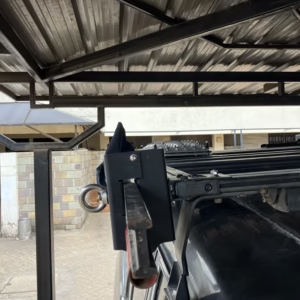
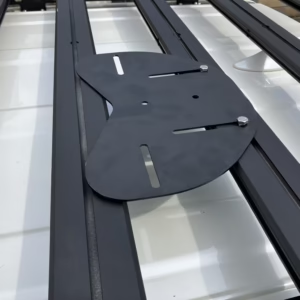
Top mount on the roof rack. Boards lay flat on top of the rack, secured by purpose-built mounts. This is the standard for most Kenyan overlanders because it keeps boards clear of drawers, the fridge and the canopy awning. Pair with our Roof Rack Mounts for Recovery Boards (Top), which bolt straight into our vehicle-specific rack pattern.
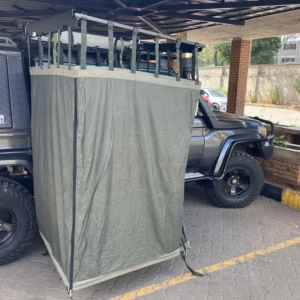
Flat side mount. For drivers who want to free up roof real estate for a rooftop tent or shower cubicle, a flat side mount keeps boards low-profile and reachable without a stepladder. The MAXTRAX Flat Mount is purpose-built for this position and works across our vehicle-specific roof rack range.
Angled mount. If your rooftop tent or solar panels claim the flat top space, an angled mount tilts the boards so they fit alongside other gear. The MAXTRAX Angled Mount is a popular pairing for Land Cruiser 100 and 200 Series builds.
These mounts attach to vehicle-specific roof racks across our range. As one example, our Land Cruiser 100 Series Roof Rack takes either top or side mounts without drilling. The same logic applies to the 79 Series, Prado 150, Defender 110 and other rigs.
Kenyan Terrain: Where Recovery Boards Earn Their Keep
Lake Magadi and the soda pans. Soft fine sand and crusted soda surfaces that look firm and are not. Wheel-deep bog-downs are common when drivers stop to photograph flamingos. Boards with strong lugs and a wide, flat profile work best.
Watamu, Diani and the coastal beach tracks. Loose dry sand above the high-tide line, firmer wet sand below. The mid-zone is where vehicles get stuck. Air down before driving onto sand, never after. The Kenya Meteorological Department tide and rainfall forecasts are a useful pre-trip check.
Post-rain murram. Murram becomes greasy and rutted after rain. Boards in bridging mode are particularly useful for crossing wheel-cut ruts on rural C-class roads.
The Loiyangalani approach. Long stretches of soft sand and broken volcanic rock on the Lake Turkana run. Boards plus aired-down tyres are standard kit.
Tsavo black-cotton and the Mara crossings. The most demanding mud terrain in Kenya. Black-cotton grips boards as much as it grips tyres. Choose a clean, deep lug pattern that scrapes clear, and carry a scraper for the residue. Always check route conditions and conservancy regulations before crossing seasonal rivers.
How Many Boards, and What Setup
For weekend overlanders running Magadi, Naivasha, the Aberdares and coastal trips, a pair of top-mounted boards is enough. For Lake Turkana runs, Mara wet-season trips and rigs with a rooftop tent, four boards with both top and side mounts give you the bridging option. Add a small folding shovel and a scraper for black-cotton residue. The full self-recovery kit pairs the boards with a vehicle-specific roof rack, the right mounts, a canopy awning for shade in coastal heat (see The Canopy Awning), a drawer system for tools and a tyre deflator, and a compatible jack.
The Bottom Line
If you drive Kenyan sand, beaches, murram or black-cotton, recovery boards are not a luxury. They are the fastest single-vehicle self-recovery tool available, they fit on any decent roof rack, and they work where a winch or shovel will not. Choose a strong load rating, UV-stable purpose-built materials, a deep lug pattern and stack-ability, then mount them where you can reach them without unloading the rig.
Browse our recovery board mount range and matching vehicle-specific roof racks at the Ultra Red Outdoors shop, or use our contact page for a setup quote tailored to your rig and the trips you plan to run.
Built and fitted in Nairobi by Ultrared Outdoors
Every product mentioned on this page is designed, fabricated and professionally installed by our team in the Ultrared Outdoors workshop on Old Mombasa Road, Nairobi. We custom-fit each kit to your specific vehicle on the bench, then install it in-house. We do not ship flat-packed parts and walk away, and we do not work from templates that “almost fit”. Every aluminium roof rack, drawer system and 270-degree canopy awning we make is tested in real Kenyan conditions before it leaves the workshop floor.
We have built rigs for safari operators heading into the Mara, expedition teams crossing the Chalbi, and weekend overlanders who just want to camp comfortably in Naivasha or on Mount Kenya tracks. Whatever the use case, the build is custom to the vehicle and the way the vehicle is actually used. Request a quote with your vehicle make, generation and intended use, and our team will scope a build for you.