
 Best Seller
Overlanding LED Lighting Buyer Guide for Kenyan Conditions
Choosing the right overlanding LED lighting Kenya setup is the difference between a relaxed Mara evening and a frantic dinner cooked by a phone torch. Vehicle interior bulbs were never designed for camp duty: they wash out faces, attract every insect within fifty metres, and drain the starter battery while you eat. A purpose-built overland light kit fixes all three problems for less weight than a single jerry can.
This overlanding light buyer guide walks through what actually matters when you choose vehicle camp lighting for Kenyan conditions: dimming, colour temperature, mounting, 12V integration, power draw, and build quality.
Why dedicated camp lighting beats the vehicle interior light
Vehicle dome lights have one job: a brief flash of cool white when a door opens. They fail at camp because they sit inside the cab, they pull current from the starter battery with no dimming, and the colour temperature is harsh enough to ruin night vision before you sit down.
A purpose-built camp light mounts where you actually need it — under the awning, at the kitchen, over the drawer slide — and lets you set brightness and tone for the moment. Dim warm light for dinner. Bright cool light for changing a tyre at midnight. The vehicle stays dark and your eyes stay adjusted.
Why a dimmable LED camp light is the highest-leverage feature
If you only get one feature right, get dimmable. A dimmable LED camp light does three things a fixed-output light cannot.
It preserves battery on multi-day trips: running a 5W light at 30% brightness for four hours uses far less power than full output, which directly extends how long your fridge can run before recharge. It protects night vision, because dimmed warm light keeps your eyes adapted to the surroundings — useful when something rustles in the bush. And it sets ambience: a low warm glow for dinner and a brighter setting for cooking is the simplest upgrade you can make to a camp.
Warm vs cool colour temperature: when each works
Single-colour lights force a compromise. A two-colour LED that switches or blends between warm (around 3000K) and cool (around 6000K) covers the full range of camp tasks.
- Warm white (cooking and relaxing): easier on the eyes, attracts fewer insects, makes food look like food rather than a hospital tray. Use at the table and around the fire.
- Cool white (working and recovery): sharp shadow definition for changing a tyre, repacking drawers, or checking a fluid leak. Use at the engine bay or recovery point.
The classic Kenyan trip mistake is fitting a single 6000K cool light and wondering why the family is squinting through dinner. A two-colour light removes the choice.
Mounting options: where the light should sit
Where you mount the light matters as much as the light itself. The four practical options for a Kenyan overland rig:
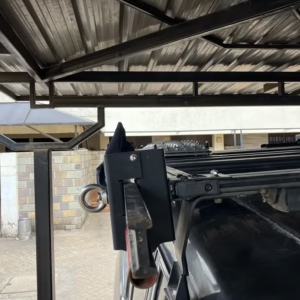
- Rack-mounted: attached under a roof rack rail, throwing light across the camp. Best for general flood. Pairs with a vehicle-specific roof rack that has dedicated mounting points.
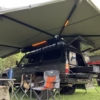
- Awning-mounted: clipped to the awning rail or fabric. Lights the kitchen from above without glaring into faces. The natural pairing with a canopy awning.
- Drawer-integrated: small lights inside or under drawers so you can find the coffee at 5am without waking camp. Common on rigs running the drawers and slides setup.
- Free-standing: a portable light on a magnetic base for tasks that move with you — the bonnet during a service, the back of the vehicle during a pack-down.
Most serious overlanders run two zones: a fixed awning or rack light for the camp, plus a portable unit for tasks.
12V vehicle integration: do it right once
A 12V camp light is only as reliable as its wiring. Three things to look for when integrating into the vehicle:
- Auxiliary battery, not starter: wire to a dual-battery setup or a portable power station. Stranding yourself because a camp light flattened the cranking battery is a Kenya bush classic.
- Inline fuse close to the source: protects the wiring run, not just the light.
- Quality switches and connectors: sealed switches, crimped terminals, connector types you can replace in the field (Anderson plugs and weatherproof DC barrels are easy to source in Nairobi).
Power draw and battery capacity for multi-day trips
A typical 12V camp light pulls between 3W and 12W depending on size and brightness setting. For a four-night trip running four hours per evening at medium brightness, total draw is roughly 100Wh to 200Wh — comfortable for any second battery or 500Wh-plus power station running alongside a fridge. The real budget killer is leaving lights on all night, so build the habit of switching off when you zip the awning down.
Kenya-specific conditions to design around
Kenyan camping is not the same as a European overland trip. Four conditions specifically affect lighting choice:
- Insects: bright cool light pulls every flying insect within range, especially at coastal camps and around lakes. Warm light attracts far fewer. Dim warm at dinner is the practical defence.
- Dust: murram and savannah dust gets into every seam. A sealed unit (IP65 or higher) keeps function intact across a Tsavo or Suguta trip.
- Humidity: coastal trips into Watamu, Kilifi, or Lamu are humid year-round. Lights with poor sealing corrode at the connector first; stainless or marine-grade fasteners hold up.
- Altitude shifts: a Mt Kenya or Aberdares trip can drop temperature by 20 degrees Celsius from departure. LED output is broadly stable, but cheap power supplies flicker on cold mornings — a sign of a poor driver circuit.
The Kenya Wildlife Service publishes campsite guidance for KWS-managed parks, and AA Kenya covers the road and terrain conditions that affect vehicle electrical systems.
Build quality criteria for overlanding LED lighting Kenya buyers
When you compare a 4×4 LED light Kenya spec sheet, weigh four numbers and one feel test:
- IP rating: minimum IP65 for a Kenyan trip; IP67 is better. Below IP54 is a road-trip light, not an overland one.
- Beam angle: 120 degrees for camp flood; 60 degrees for task light. A 30-degree spot is for the bonnet, not the dinner table.
- Brightness range: a usable dim setting matters more than peak lumens. A light that only dims to 70% is not a dimmable light.
- Switch quality: press it twenty times in the shop. If it feels mushy or sticks, it will fail in dust.
- Build feel: sealed body, no sharp moulding lines, fasteners that look like they survive ten removals.
Our recommendation: a dimmable two-colour LED as your first overland light
If you are choosing a single overland camp light to do most of the work, the Dimmable 2-Colour LED Light is the one we fit most often on Kenyan rigs. It runs warm and cool, dims smoothly across the full range, and uses premium-grade components rated for the dust, humidity, and altitude shifts we see on customer trips. It mounts neatly under a canopy awning, on a rack rail, or as a portable unit.
For trip-builders who want the matched setup, pair the light with a vehicle-specific awning and roof rack so the mounting points are already there. Browse the full range on the Ultra Red Outdoors shop.
Built and fitted in Nairobi by Ultrared Outdoors
Every product mentioned on this page is designed, fabricated and professionally installed by our team in the Ultrared Outdoors workshop on Old Mombasa Road, Nairobi. We custom-fit each kit to your specific vehicle on the bench, then install it in-house. We do not ship flat-packed parts and walk away, and we do not work from templates that “almost fit”. Every aluminium roof rack, drawer system and 270-degree canopy awning we make is tested in real Kenyan conditions before it leaves the workshop floor.
We have built rigs for safari operators heading into the Mara, expedition teams crossing the Chalbi, and weekend overlanders who just want to camp comfortably in Naivasha or on Mount Kenya tracks. Whatever the use case, the build is custom to the vehicle and the way the vehicle is actually used. Request a quote with your vehicle make, generation and intended use, and our team will scope a build for you.