
 Best Seller
Land Rover Defender 110 Canopy Awning Setup Guide for Kenya
The Land Rover Defender 110 has a roofline that rewards a vehicle-specific awning and punishes a generic one. The flat upper rails, classic gutter geometry, and the way Defender owners actually use these trucks in Kenya all argue for a purpose-built Defender 110 canopy awning rather than a one-size-fits-all wrap. This guide walks you through what to look for, how the awning mounts on a Defender 110, and how it integrates with the rest of an overland build for Kenyan terrain.
The Defender 110 in Kenya: still the icon overlanding rig
Drive any serious safari route in Kenya and you will see Defender 110s. The platform earned its place over decades on Mara grasslands, Aberdares forest tracks, the climb to Naro Moru, and the salt-pan crossings around Lake Magadi. Owners hold onto them, restore them, and re-engineer them for long-haul expedition use. Land Rover built the 110 around payload, axle articulation, and a flat, accessible roof, and that flat roof is exactly what makes the Defender 110 such a friendly base for awning, rack, and rooftop tent integration.
The roofline characteristics matter for awning fit. A Defender 110 has a long, near-flat roof span with traditional gutter rails and clean side profiles. That gives you full-length mounting real estate without the curvature trade-offs you face on more modern monocoque SUVs. It is the reason vehicle-specific awning brackets fit cleanly on the Defender 110 and why deployment angles tend to be predictable.
Why a vehicle-specific Defender 110 awning matters
Universal awnings exist. They look fine on a showroom shelf and they can mount on almost anything. The problem comes when you take one to a real Kenyan camp. A generic awning forces the vehicle to accept the awning rather than the awning fitting the vehicle. On a Defender 110 that means either compromised mounting points, awkward deployment height, or interference with the rear-door swing.
A vehicle-specific Land Rover Defender 110 awning sets up differently. The mounting hardware lines up with the roof rack profile or the gutter rail. Deployment clears the rear door. The arm angles match the Defender 110’s actual roof height so you are not standing on tiptoes to fold it back in. And the awning length is sized to cover the side opening you will actually use, not a generic mid-size SUV.
Three things separate a vehicle-specific awning from a universal one in field use:
- Mounting: brackets designed for the Defender 110 mate to the rack or gutter without packers, shims, or workshop modification.
- Deployment: the awning swings out without fouling the rear door, side jerry can holders, or the spare wheel carrier.
- Weather behaviour: a tight, well-tensioned vehicle-specific awning sheds wind better than a loose universal fit, especially in the gusty conditions you meet on the Mara plains and at altitude.
The aluminium awning build
Canopy awnings are one of the two product lines where Ultra Red Outdoors uses aluminium, alongside roof racks. That matters for a Defender 110 build because the Defender’s payload, while generous on paper, gets eaten up fast once you add a drawer system, fridge, fuel cans, recovery gear, and a rooftop tent. Every kilogram of unnecessary weight on the roof comes at the cost of payload, fuel economy, and centre-of-gravity stability on rough tracks.
An aluminium canopy awning earns its place on three counts:
- Weight: aluminium delivers the structural strength you need for the awning frame and arms without the mass of steel. On a roof-mounted item, weight saving compounds, because you are not just carrying it, you are carrying it high.
- Durability: aluminium handles Kenya’s coastal salt air, the dry-season dust of the north, and the wet-season humidity of the central highlands without rusting through. A powder-coated finish adds a second protection layer over the aluminium itself.
- Deployment ease: a lighter awning is faster to deploy and pack down. After three weeks on the road, that difference shows in how often you actually bother to set it up.
This is the same aluminium-build logic that makes our Defender 110 Roof Rack a load-bearing platform rather than a decorative one. The awning and the rack work as a single aluminium system on top of the truck.
Mounting options for the Defender 110
A Defender 110 gives you three main mounting paths for a canopy awning. The right one depends on what else lives on your roof.
Gutter mount
The classic Defender 110 has functional rain gutters running the full length of the roof. Gutter-mounted awning brackets clamp directly onto these rails. This is the simplest and lightest mounting option, and it works well for owners who want an awning but do not run a full roof rack. The trade-off is that gutter mounts share the rail with anything else you want to clamp on, so plan ahead.
Roof rail integrated
If the truck already wears OEM-style or aftermarket roof rails, awning brackets can mate to those rails. This is a clean look and keeps the awning low to the roofline. Verify the rail load rating before committing, because the awning and the wind force on it during deployment add stress to the rail mounts.
Rack-integrated mount
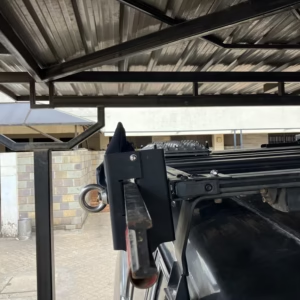
This is the option most full overland builds go with. The awning bolts to the side rail of a vehicle-specific roof rack, sharing the rack’s mounting feet and load path. It is the strongest of the three options, the most accessory-friendly (you can run lights, recovery boards, and a rooftop tent on the same rack), and the cleanest visually. Our Defender 110 Canopy Awning is built to integrate directly with the matching Defender 110 Roof Rack as a single aluminium system.
Compatibility with the full Defender 110 build
An awning is a single component in what is usually a four- or five-component overland build. On a Defender 110 the typical stack is roof rack, canopy awning, drawer system, recovery board mount, and lighting. Each component should fit the others without forcing compromises.
The Defender 110 Canopy Awning, the Defender 110 Roof Rack, and the Defender 110 Drawer System are designed as a matched set. The rack carries the awning and the rooftop accessories. The awning extends the usable footprint of the truck at camp. The drawer system organises the load bay so you do not have to dig through soft bags every time you need a tool, a stove, or a torch. A Defender 110 Roof Shelf sits between the cab and the rack, giving you a fast-grab storage zone for items you need without climbing on the bonnet.
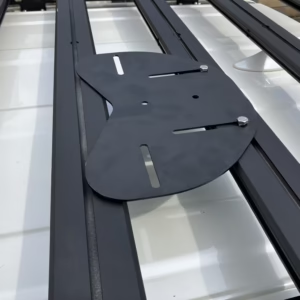
For recovery, a roof-mounted Maxtrax Flat Mount keeps recovery boards stowed flat against the rack. They stay out of the way until the moment you actually need them on a wet murram track or a Magadi sand crossing.
Deployment in safari camps, weekend trips, and expedition use
A canopy awning earns its keep in three different use cases, and a Defender 110 owner is likely to use it for all of them across a single calendar year.
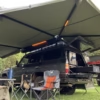
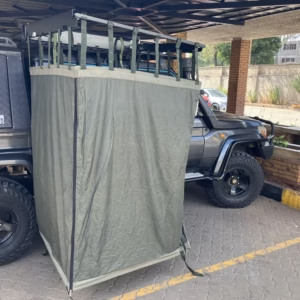
Safari camps and tour-operator deployment: tour fleets park up at lunch, deploy awnings as guest shade, and pack down again before sunset. Speed and predictability matter. A vehicle-specific awning that opens fully in under a minute and packs cleanly without snagging is what fleet managers buy for a reason. The 270-degree wraparound profile that mature canopy awnings offer covers the full side and rear of the Defender 110, giving guests space without crowding the vehicle.
Weekend trips: a quick deployment over a folding chair and a coffee setup at Hell’s Gate, Lake Naivasha, or the Aberdares matters most when the rain rolls in. Defender 110 owners doing weekend runs from Nairobi want an awning that pops out without a second pair of hands.
Expedition use: a 14- or 21-day trip up to Lake Turkana, across to the Tsavo block, or down through Tanzania puts cumulative wear on every component. The awning has to stand up to repeated deployment, sand, dust, sun, and wind without fabric stretch, frame fatigue, or hardware failure. This is where the aluminium frame and the vehicle-specific mounting pay back over the long run.
Weather considerations: Kenya wind, rain, dust, and heat
Kenyan conditions are not gentle on outdoor gear. An awning that is going to live on a Defender 110 in this country has to handle four specific weather variables.
Wind: open plains in the Mara, the Athi-Kapiti, and the northern frontier district see sustained gusts that will lift a poorly tensioned awning. Always peg the awning down at the corner attachment points when wind is forecast. Vehicle-specific awnings tension cleanly against the rack, which gives you the structural anchor a universal awning lacks.
Rain: long-rains season (March to May) and short-rains season (October to December) deliver the bulk of Kenya’s annual rainfall. Awning fabric should shed rain at the standard 270-degree pitch angle. Inspect the seams after a wet trip, because that is where any fabric weakness will show first.
Dust: the dry season brings fine, abrasive dust on every track north of Isiolo and south of Magadi. Fold the awning back into its bag while transiting heavy-dust zones to keep the fabric and the hinge mechanism clean.
Heat and UV: equatorial sun degrades fabrics over years. UV-resistant fabric and a powder-coated frame extend the working life of the awning. Outside Online has covered the long-term durability differences between budget and purpose-built awning fabrics in field testing, and the gap widens with every additional year of equatorial exposure.
Maintenance and storage
An awning lasts longer when you treat it like a working component, not a permanent fixture. Three habits matter.
First, dry the fabric before packing it down for long-term storage. Folding a damp awning into its bag is the single fastest way to develop mildew on the fabric. If you packed up wet, redeploy the awning at home, let it dry in shade, then pack it down again.
Second, check the hinges, brackets, and bolts every few months. Vibration on rough roads loosens fasteners, and a loose awning bracket is the kind of thing that does not announce itself until something snaps mid-deployment.
Third, rinse the frame after coastal trips. Salt air sits on aluminium and starts working through the powder-coat finish at any chip or scratch. A fresh-water rinse takes five minutes and adds years to the frame.
The Ultra Red Outdoors approach
We build vehicle-specific awnings, racks, and storage systems in Kenya for Kenyan conditions. We were the first locally-manufactured aluminium roof rack producer in Kenya, and the canopy awning line carries the same aluminium-build philosophy. Every Defender 110 canopy awning we ship is built to mate cleanly with our matching Defender 110 rack and drawer system, because we engineer them as a single ecosystem rather than as separate parts that happen to share a vehicle name.
Tour operators, weekend overlanders, and full-time expedition drivers all run different versions of the same Defender 110 build. The components stay the same. The use case changes.
Ready to spec your Defender 110 build
Start with the awning, then layer in the rest of the system. The Defender 110 Canopy Awning is the shade-and-shelter foundation. Add the Defender 110 Roof Rack for load capacity and mounting integration. Finish with the Defender 110 Drawer System for organised load-bay storage, and round it off from our drawers and slides range or the full shop. For fleet pricing, custom builds, or fitment questions on a non-standard Defender 110, get in touch and we will scope the build with you.
Built and fitted in Nairobi by Ultrared Outdoors
Every product mentioned on this page is designed, fabricated and professionally installed by our team in the Ultrared Outdoors workshop on Old Mombasa Road, Nairobi. We custom-fit each kit to your specific vehicle on the bench, then install it in-house. We do not ship flat-packed parts and walk away, and we do not work from templates that “almost fit”. Every aluminium roof rack, drawer system and 270-degree canopy awning we make is tested in real Kenyan conditions before it leaves the workshop floor.
We have built rigs for safari operators heading into the Mara, expedition teams crossing the Chalbi, and weekend overlanders who just want to camp comfortably in Naivasha or on Mount Kenya tracks. Whatever the use case, the build is custom to the vehicle and the way the vehicle is actually used. Request a quote with your vehicle make, generation and intended use, and our team will scope a build for you.