
 Best Seller
270-Degree vs 180-Degree Vehicle Awnings: Which to Buy in Kenya
If you’re shopping for a vehicle awning in Kenya right now, you’re almost certainly weighing a 270-degree wraparound against a simpler 180-degree design. The choice isn’t about which is “better.” It’s about coverage area against weight, price, and how often you actually deploy the thing. Get this call right and you’ll thank yourself every time you pull off the road. Get it wrong and you’ll either be lugging extra weight you never use, or fighting for shade you don’t have.
This guide is the comparison every Kenyan overlander, weekend camper, and safari operator needs before buying. We build both designs locally for over thirty vehicle models, so the trade-offs below come from fitting these awnings to real Kenyan rigs running real Kenyan terrain.
What you’re really deciding: coverage vs weight and cost
Both awning styles do the same job: extend a fabric roof off the side of your vehicle so you can cook, change, work on a flat tyre, or set up a chair without baking in the sun. The difference is how far that fabric wraps.
- 180-degree awnings deploy in a straight line off one side of the vehicle. Coverage is rectangular, roughly the length of your roof line by about two metres outward.
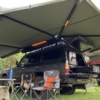
- 270-degree awnings wrap around the rear corner of the vehicle, covering the side and the back. You get an L-shaped shaded zone large enough for a full camp kitchen plus a sitting area.
The 270 gives you more shade. The 180 weighs less and costs less. That’s the headline. Everything else in this comparison is detail that helps you choose the right one for your specific use case.
180-degree awning: when simpler is smarter
The 180-degree design is the workhorse of the Kenyan overland scene. It deploys fast, weighs less, and covers enough ground for a couple cooking, eating, or sheltering from a sudden afternoon shower.
Where it wins:
- Solo overlanders and couples. If your camp is two chairs, a Jetboil, and a fold-out table, you don’t need 270 degrees of coverage. You need 180 to be quick to deploy, quick to pack, and easy to handle alone.
- Weekenders. For Naivasha, Magadi, or a Kenyan coast run where you set up once and pack down once, deployment time matters less than weight and pack-down volume.
- Roof load constraints. A 180 sits lighter on your roof rack, which leaves headroom for a rooftop tent, jerry cans, recovery boards, or a roof shelf. On a fully-loaded rig, weight savings on the awning free up payload elsewhere.
- Budget-conscious buyers. A 180 sits in a lower price tier than its 270 counterpart, with simpler build and fewer support arms. If this is your first awning and you’re testing how often you actually use it, the 180 is a smart entry point.
Where it falls short: a 180 leaves the rear of the vehicle exposed. If you’re cooking out the back of an LC80 or a Hilux double cab, you’ll be in shade at the side and full sun at the tailgate. For a family of four, this gets old fast.
270-degree awning: when coverage is the whole point
The 270 is the “I want my whole camp shaded” awning. It wraps from the side around the rear corner, giving you a continuous shaded L that runs the full length of your vehicle plus a generous chunk behind it.
Where it wins:
- Family setups. Four people, a fridge slide off the tailgate, a kitchen station, two camp chairs and a table — the 270 covers the lot. Kids stay in shade. Cooking happens in shade. Rain shelter is real, not a polite suggestion.
- Safari camp feel. A 270 turns a vehicle into a camp. For longer stays — three nights at a Mara conservancy, a week at a private bush camp, a Loisaba run — the 270 is what makes the vehicle feel like a base, not a stop.
- Fleet and tour operator use. If you run a safari operation, you’re optimising for guest experience. Guests want shade for sundowners, shade for breakfast, and shade when the sun cuts through the bush at four in the afternoon. The 270 delivers that without you needing to pitch a separate gazebo.
- Hot, exposed terrain. Lake Magadi, Chalbi, Suguta Valley, the Maasai Mara dry season — when the sun is overhead and there is no tree cover, every extra square metre of shade matters. A 180 gives you a strip. A 270 gives you a room.
Where it falls short: the 270 weighs more, costs more, takes longer to deploy (you’re swinging a wraparound arm system around the back of the vehicle), and demands a roof rack that can carry the load without flexing.
Mounting and weight on your roof rack
This is the question most buyers underestimate. An awning is not a stand-alone purchase — it’s a load that lives on your roof rack for the life of the vehicle. The 270 vs 180 awning Kenya decision is partly a roof rack decision.
A 180 mounts to the side rail of a roof rack with two or three brackets. Load distribution is even and the centre of gravity stays low. Most aftermarket roof racks handle a 180 without complaint.
A 270 mounts at one or two pivot points and the wraparound arm extends well beyond the rack footprint when stowed. The cantilever loads are higher. You want a roof rack that’s been engineered for awning compatibility — ideally one with reinforced side rails and dedicated mounting points. A flimsy universal rack is not the place to hang a 270.
Our Toyota Land Cruiser 200 Series Roof Rack is built from extruded aluminium profiles and engineered to carry a 270 without flex. The same applies across our vehicle-specific aluminium roof rack range. If you’re running a roof rack from a different source, check the manufacturer’s awning load spec before you commit to a 270.
Aluminium build: what it means for the awning itself
Both our 180 and 270 awnings use an aluminium frame and aluminium support arms. We mention this because it changes how the awning behaves in real conditions.
- Weight. Aluminium gives us a structural awning at roughly half the weight of a steel-framed equivalent. On a 270, that weight saving is the difference between a comfortable roof load and an awkward one.
- Corrosion resistance. Coastal Kenya is brutal on steel. Salt air at Watamu, Diani, and Kilifi will pit unprotected steel within a season. Aluminium handles salt exposure with simple rinsing and is the right material for any vehicle that sees the coast more than once a year.
- Powder-coated finish. Both awning ranges ship powder-coated for UV resistance. The Kenyan equatorial sun degrades unprotected metal fast. The coating buys you years of clean appearance.
Poles, pegs, and guy lines for Kenyan winds
This is where Kenyan-specific knowledge separates a guide written by someone who’s actually camped here from one that wasn’t. Wind matters more in Kenya than in temperate climates because the terrain is open, the gusts are sudden, and the awning becomes a sail in seconds.
The Kenya Meteorological Department publishes wind data for major regions, and the patterns are worth understanding before you camp anywhere exposed:
- Maasai Mara and the Loita plains: afternoon thermals build steadily from around 1 pm. By late afternoon, sustained winds are common and gusts can spike. Always peg every leg and run guy lines.
- Lake Magadi and the Rift floor: mid-morning convective wind off the soda flats. Hot, dry, and persistent. Guy lines are not optional.
- Coastal Kenya: the kusi (south-east monsoon) runs roughly April through September, then flips to the kaskazi (north-east monsoon) October through March. Pitch awnings perpendicular to the prevailing wind, never broadside.
- Mount Kenya foothills and central highlands: mostly sheltered, but valley wind can funnel hard at sunset. Watch the trees before you pitch.
Practical setup:
- Always peg every support leg. Always. Even on a windless evening, conditions can change in fifteen minutes.
- Use guy lines on at least the two outer corners. We supply guy line kits with every awning.
- If wind picks up beyond what your rig can handle, retract the awning. A torn fabric panel costs more than ten minutes of inconvenience.
- For long stays, drive sand pegs deep on soft ground. Rocky ground needs heavy-duty pegs and a rubber mallet.
Vehicle-specific compatibility
One of the reasons we build awnings vehicle by vehicle is that mounting brackets are not universal. The roofline of a Land Cruiser 100 is not the roofline of a Defender 110. A 270 that fits a Prado 150 won’t bolt straight to a Pajero G4 without bracket adapters.
Quick reference for the most common Kenyan platforms:
- Toyota Land Cruiser 100 Series: our LC100 Canopy Awning is the most-fitted awning on our line. Both 180 and 270 versions available.
- Toyota Land Cruiser 200 Series: pair the awning with the LC200 Roof Rack for a clean factory-look install.
- Toyota Prado 150: our Prado 150 Canopy Awning is engineered for the 150-series roofline and pairs with the matching Prado 150 roof rack.
- Land Rover Defender 110 Classic: dedicated bracket kit, available in 180 and 270 configurations.
- Toyota Hilux Double Cab (2015+): the load bay roof rack accepts our awning range with no modification.
- Mitsubishi Pajero Generation 4: the Pajero G4 Canopy Awning uses a dedicated bracket set for both LWB and SWB rooflines.
If your vehicle isn’t on this list, we still likely build for it. We currently fit awnings to over thirty platforms including Discovery 1 through 4, FJ Cruiser, Suzuki Jimny (third and fourth gen), Land Cruiser 60, 76, 78, 79, and 80 series, and the Range Rover Classic. The right answer is usually a quick call to confirm bracket fitment for your year and trim.
Decision framework: which to choose
Use this as a quick filter:
Choose a 270-degree awning if:
- You camp with a family or group of three or more
- You stay at a campsite for more than one night per trip
- Your trips include long, exposed terrain (Mara, Magadi, Suguta, Chalbi)
- You run a safari or tour operation and need a guest-comfortable shaded area
- You already have a roof rack rated for the cantilever load, or you’re buying both together
- You want one piece of gear that handles both shade and rain shelter for the whole rig
Choose a 180-degree awning if:
- You camp solo or as a couple
- Most of your trips are one or two nights
- Pack-down speed matters more to you than maximum coverage
- You’re weight-conscious because the rest of your roof rack is already loaded
- You’re pricing this against a tight build budget and want to put the savings into a fridge slide, drawer system, or recovery gear
- You’re new to vehicle awnings and want a simpler first install
If you’re somewhere in the middle, the honest answer is: most buyers who hesitate end up wishing they had bought the 270. Coverage is the thing you stop noticing once you have enough of it, and the thing you keep noticing when you don’t.
Where to buy and what to ask
If you’re buying a vehicle awning in Kenya, ask these questions of any supplier before you commit:
- Is the awning built specifically for my vehicle, or is it a universal product I’ll need to adapt?
- What roof rack is it engineered to mount on, and is mine compatible?
- What’s the warranty on the frame, the fabric, and the powder coat?
- Can I see the product fitted to a vehicle like mine before I buy?
- If I camp on the coast or in a salt-air environment, what care does the awning need?
For overlanding context and conservancy camp planning, the Kenya Wildlife Service publishes camping rules and approved sites for parks and reserves — worth a read before you finalise gear for a trip.
The Ultra Red Outdoors awning range
We manufacture our awnings in Kenya, fit them to your specific vehicle, and back them with direct after-sales support. Every awning ships with mounting brackets, guy line kit, and pegs. Both 180 and 270 configurations are available across our vehicle-specific range.
Browse The Canopy Awning for the full specification on our flagship awning, see vehicle-specific awning fitments above, or visit the full Ultra Red Outdoors shop for the complete overlanding range. For a fitment quote on your specific vehicle, year, and trim, get in touch.
Pick the awning that matches the trips you actually take, not the trips you imagine. The right call here pays back over years of camping.
Built and fitted in Nairobi by Ultrared Outdoors
Every product mentioned on this page is designed, fabricated and professionally installed by our team in the Ultrared Outdoors workshop on Old Mombasa Road, Nairobi. We custom-fit each kit to your specific vehicle on the bench, then install it in-house. We do not ship flat-packed parts and walk away, and we do not work from templates that “almost fit”. Every aluminium roof rack, drawer system and 270-degree canopy awning we make is tested in real Kenyan conditions before it leaves the workshop floor.
We have built rigs for safari operators heading into the Mara, expedition teams crossing the Chalbi, and weekend overlanders who just want to camp comfortably in Naivasha or on Mount Kenya tracks. Whatever the use case, the build is custom to the vehicle and the way the vehicle is actually used. Request a quote with your vehicle make, generation and intended use, and our team will scope a build for you.